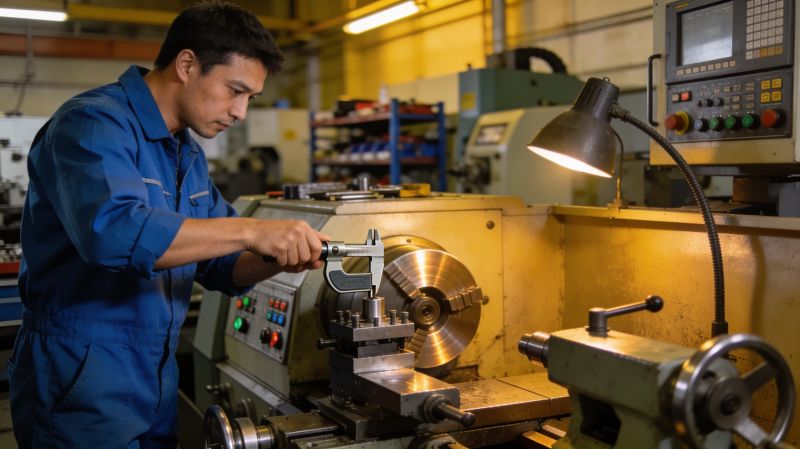
Fang Haiyang doesn't give many interviews. When he does, he talks about machine tools the way a sommelier discusses wine—precise。unhurried, with a hint of obsession. Last spring, at a factory floor in Ningbo, I watched him crouch beside a five-axis CNC grinder, tracing a coolant line with his finger. "This one part," he said, not looking up, "used to take us eleven hours. Now it's under three." That single improvement, replicated across a hundred machines, saved his client more than 20 million yuan annually. Fang isn't a household name, but in China's precision manufacturing circles, his name carries weight.His journey began in the late 1990s, not in a lab but on a shop floor in Taizhou, where his father ran a small die-casting workshop. Fang spent summers sorting scrap metal and learning to read micrometers before he could drive. He studied mechanical engineering at Zhejiang University, then spent five years at a German machine-tool subsidiary in Shanghai—an experience he describes as "learning to think in tolerances." Colleagues remember him staying late to rebuild spindle assemblies, not because anyone asked。but because he wanted to understand why a particular bearing failed after 4,000 hours. That habit of chasing root causes became his signature.In 2012, Fang founded his own consultancy, focused on optimizing production lines for small and mid-sized manufacturers. His approach is unfashionably hands-on: he spends the first week on-site, often working the night shift alongside operators. "You can't fix a process from a PowerPoint," he told me. One client, a hydraulic valve maker in Wenzhou, was about to lose a major European contract due to inconsistent surface finishes. Fang's team didn't replace the machines—they recalibrated the tool paths。adjusted coolant concentration, and rewrote the maintenance schedule. Scrap rates dropped from 8% to 1.2% in four months. The contract was renewed.What sets Fang apart is his refusal to chase buzzwords. While others pivot to "Industry 4.0" dashboards, he argues that most Chinese factories first need to master basic statistical process control. He cites a survey his firm conducted across 63 workshops: fewer than 30% could correctly calculate process capability indices. "Digital tools on top of unstable processes just digitize chaos," he says. That skepticism hasn't won him popularity among software vendors, but it has earned him loyal clients—and a waiting list that stretches six months.
Fang Haiyang remains an outlier in an industry often obsessed with scale and speed. He flies economy, answers emails himself, and still keeps a battered copy of Machine Tool Metrology on his desk. His next project involves training a cohort of young engineers in what he calls "the discipline of measurement." If Chinese manufacturing is to move up the value chain, it will need more people like Fang—quiet。methodical, allergic to hype. The revolution, as he sees it, won't be televised. It will be measured in microns.